
2026-03-26
Agile Beyond the Frameworks
Agile has been around for over 20 years and has been largely adopted by most organisations involved in product development, with varying degrees of success. The most popular frameworks, such as Scrum or Scaled Agile, have been commercialised and sold as bulletproof choices to deliver products successfully and quickly, regardless of the level of complexity involved.
But lately, the trend has reversed. Some organisations are abandoning predefined frameworks or have started questioning the applicability of Agile to their operations or even their culture.
Agile remains highly relevant today, provided it is applied to the right contexts, supported by mature engineering practices and aligned with strong organisational buy-in.
From Manifesto to Mainstream
Agile was formally introduced in 2001 as a set of values and principles defined by a group of software development experts, captured in what was the Manifesto for Agile Software Development. After the initial diffidence, especially from the corporate establishment, its use started to spread, also due to the success of companies like Netflix and Spotify, which, at least initially, embedded Agile best practices not only into their engineering teams but also into their corporate culture.
This pursuit of engineering excellence, extended across the entire organisation, propelled them into a new sphere where technology was not merely supporting the business but acting as a driving force for profound digital transformation.
The Evolution of Agile Adoption
Although still widely popular, industry estimates place the global Enterprise Agile Transformation Services market at nearly $50 billion in 2025, with a CAGR of 18.5% through to 2035, the trust in Agile has started to decline and the way it is implemented is evolving.
Data from the 18th State of Agile Report, published by Digital.ai at the end of 2025, confirms that while adoption remains high (80% of the organisations interviewed use some form of Agile practices), 74% do not rely on a specific framework but instead have shifted towards customised or adapted approaches.
Moreover, although more than 50% of companies have successfully integrated DevOps tools into their delivery pipelines, 63% still experience quality issues. This is somewhat surprising considering that one of the best returns on investment from increased automation should be the reduction of human error and the consequent improvement in overall reliability.
Following Agile vs Becoming Agile
One of the misconceptions about Agile has often been that applying a process or obtaining a professional certification is sufficient to embody an Agile mindset.
In practice, it is relatively easy to follow Agile, but it is not as easy to become Agile. While the former is about ceremonies and defined roles, becoming Agile requires a deeper transformation that transcends rigid implementations and extends beyond technology departments. It is a longer and more complex path, but it can bear fruit even before full maturity is reached.
The Four Dimensions of Agility
Agile initiatives often fail not because of a single weakness, but because they require coordinated change across multiple aspects of an organisation. Understanding these interdependencies is key to making Agile effective in practice.
There are four key dimensions that organisations need to navigate when planning an Agile transformation:
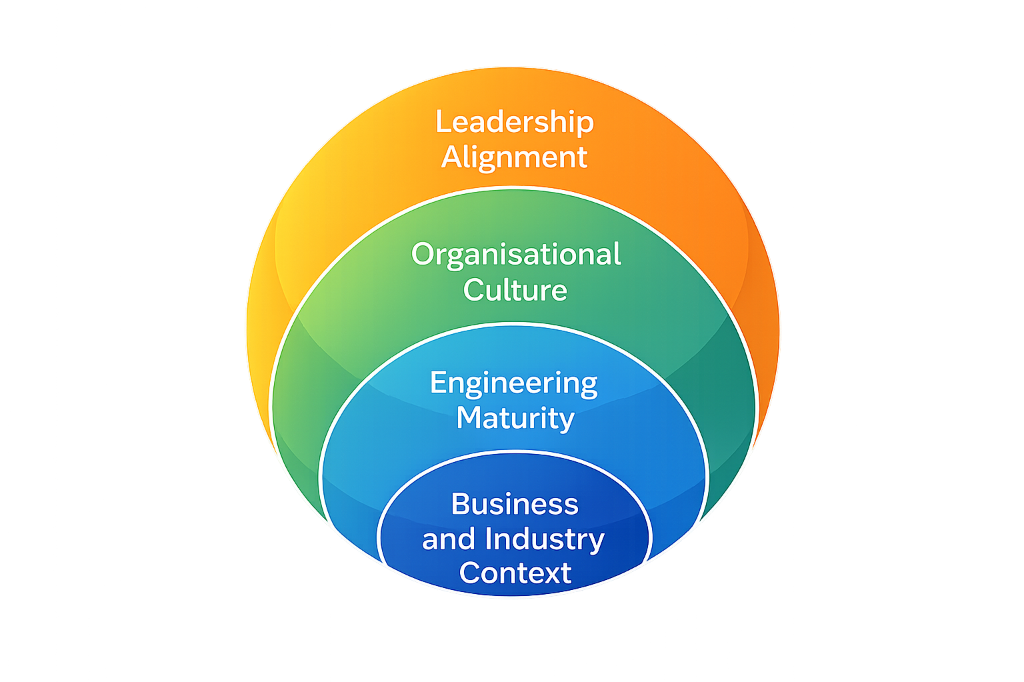
All these elements are equally important and their comprehension is critical in shaping the organisation’s ability to become truly Agile.
Business and Industry Context
Agile methodologies work very well for exploratory initiatives or when delivering changes quickly is important and tolerated, by customers or users.
In more complex and regulated environments, or when significant alignment among different parties is required, Agile can only work effectively when supported by engineering techniques that allow teams to release changes safely and incrementally.
One example is the use of feature flags, which make it possible to deploy code into production without exposing it immediately to all users. Without techniques of this kind, organisations risk reducing Agile to an iterative planning process rather than a model for delivering working software rapidly and safely.
Agile also fits very well with start-ups that, once past their initial prototyping phase and beginning to scale, are looking to strengthen their products by improving robustness and stability while still being able to turn around features at a competitive pace.
Not all businesses are structured or have the appetite to respond quickly to market demands. Therefore, a meaningful Agile transformation should consider the realistic ambitions and overall strategy of the organisation.
The Engineering Foundation of Agility
Although Agile was never solely about engineering, in practice it only works when underpinned by strong engineering capability. For this reason, robust engineering practices that enable teams to deliver and, when needed, safely roll back changes form the foundation for embedding Agile ways of working across the organisation.
When I refer to engineering practices, I mean not only the implementation of CI/CD pipelines or leveraging platforms such as Kubernetes, but also the safeguards - such as test automation, consistent environments and reliable data - that build confidence in the end result.
Automation tools are essential to enable continuous delivery and incremental releases. However, without robust validation of functionality and integration in environments that closely mirror production, increased speed will inevitably come at the expense of quality - turning Agile into a faster delivery process rather than a more reliable one. This is reflected in the DORA metrics, which emphasise not only delivery frequency, but how reliably those changes perform and how quickly issues are resolved.
Organisational Culture
Organisational culture plays a critical role in enabling Agile beyond engineering teams. Becoming Agile requires a shift in behaviours, decision-making and accountability, where teams are empowered to respond to change and continuously improve. Without this cultural foundation, Agile risks remaining a set of practices rather than a true organisational capability.
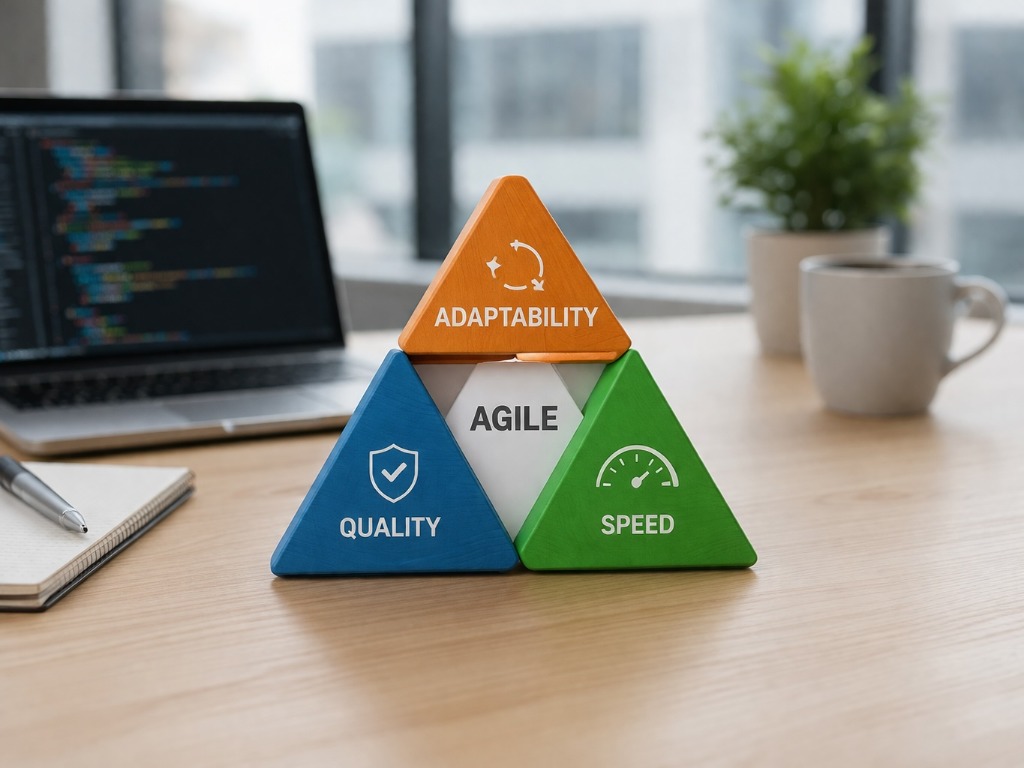
Ultimately, it is about the willingness to transform into a model that treats adaptability, quality and speed as equally non-negotiable, and to embed this balance into everyday behaviours and decision-making.
Agility Requires Leadership
Regardless of the use case or the size of the organisation, a strong buy-in from senior leadership is critical. They must fully comprehend the implications of an Agile approach and be clear about the business value delivered in alignment with strategic objectives.
Many Agile transformations fail to take hold or remain confined within engineering teams, when senior leaders are not prepared to actively support the journey by making deliberate trade-offs around priorities, investment and organisational design.
Conclusion
Agile is not at the end of its life; however, in many cases it has remained confined within technology teams or interpreted merely as a way to remain responsive without embracing the subtleties of a true Agile culture.
Organisations that succeed are those able to align business context, engineering capability, culture and leadership around a common objective, treating them not as independent factors but as a cohesive system.
As AI becomes increasingly embedded in the software development lifecycle, the way we build and deliver products will continue to evolve. What will not change is the need to balance adaptability, quality and speed, a tension that Agile should always seek to address.